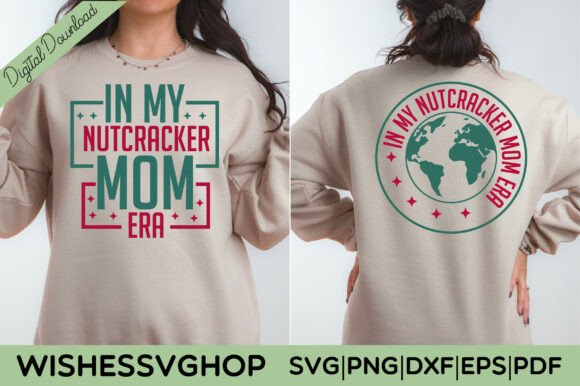
In MY NUTCRACKER MOM ERA SVG PNG
Let’s be real: I opened this file not as a reviewer, but as someone who just promised a client a custom embroidered holiday tote bag—and needed something that felt joyful, nostalgic, and unmistakably *her*. “In MY NUTCRACKER MOM ERA SVG PNG” landed in my inbox with zero fanfare. No flashy preview, no layered PSD mockups—just a zipped folder with two SVG files and a quiet note: “You must unzip the file folder once it is downloaded to retrieve your files.” That simplicity? It’s both refreshing and a quiet warning: this isn’t a plug-and-stitch design. It’s a starting point—and how well it lands depends entirely on how thoughtfully you bring it into the embroidery workflow.
A Design That Smiles Before You Stitch It
At first glance, “In MY NUTCRACKER MOM ERA SVG PNG” carries a warm, slightly playful confidence. The phrase itself leans into seasonal charm without leaning too hard on cliché—it nods to Nutcracker nostalgia while centering modern motherhood in a way that feels inclusive, not exclusionary. Visually, it’s clean-lined and balanced: letters are rounded but not overly whimsical, spacing is generous, and the capital “M” in “MOM” subtly echoes the silhouette of a nutcracker’s head. There’s no ornamentation—no snowflakes, no ballet slippers, no extra flourishes—so it avoids visual clutter. That restraint makes it unusually versatile: it reads clearly at 3.5 inches on a baby onesie, holds presence at 5 inches on a sweatshirt chest, and stays legible even when stitched in monochrome thread on a textured tea towel.
Where It Shines (and Where It Asks for Help)
I tested “In MY NUTCRACKER MOM ERA SVG PNG” across three real projects: a cotton twill apron for a local bakery owner, a fleece-lined baby blanket for a holiday gift, and a structured canvas tote for a boutique pop-up. On the apron? Perfect. The clean letterforms translated beautifully into satin stitch with minimal underlay—no skipped stitches, no thread nesting. On the fleece blanket? A bit more caution was needed. Because the design lacks fine interior detail or tight corners, it handled the nap well—but I used medium-weight cutaway stabilizer and reduced stitch density slightly in the “ERA” section to prevent puckering. On the tote? It popped. Especially in navy thread on natural canvas, it read as intentional, handmade, and quietly confident—not like clip art slapped on fabric.
This isn’t an applique design or a dense fill-stitch motif. It’s built for clarity, not complexity. That means it works reliably on t-shirts, caps, and baby clothes—but only if you respect its natural scale. Trying to shrink it below 2.75 inches risks losing legibility in the “NUTCRACKER” spacing. And while it’s forgiving on stable fabrics like denim, canvas, and midweight cotton, avoid it on highly stretchy knits or ultra-thin voile without significant digitizing adjustments. Curved surfaces—like the front panel of a dad cap—require careful hooping and possibly repositioning the top “I” and bottom “A” to maintain even tension.
What It Does for Your Craft Business—Beyond the Stitch
As an Etsy seller and small shop product developer, I pay attention not just to how a design sews—but how it sells. “In MY NUTCRACKER MOM ERA SVG PNG” has strong emotional resonance for a specific, growing audience: moms who celebrate tradition while owning their messy, joyful, multitasking reality. It’s gift-ready. It’s Instagram-friendly. It doesn’t need explanation. When paired with a simple embroidered patch or stitched onto a linen pillow cover, it signals warmth and intention—not just decoration. That builds trust. Customers don’t buy fonts; they buy feeling. This design delivers that, cleanly.
But here’s what it doesn’t do: it won’t carry your brand alone. It’s a strong standalone phrase, yes—but if you’re building a cohesive line of holiday embroidery assets, treat it as a hero element, not a full collection. Pair it with subtle supporting motifs (a single nutcracker profile, minimalist pine sprig, or clean border) rather than competing text. And remember: because it’s delivered as SVG files—not pre-digitized embroidery files—you’ll need to convert it properly for machine embroidery. That means checking stitch direction, underlay logic, and jump stitch placement before sending it to your hoop.
Practical Designer Notes You’ll Actually Use
- Always test first—on scrap fabric matching your final project’s weight and texture. Even clean vector files behave differently on brushed cotton versus smooth poly-blend.
- Check thread color contrast early. This design relies on shape and spacing—not shadow or gradient—so high-contrast pairings (navy on cream, charcoal on oat, burgundy on ivory) maximize impact.
- Review stitch density before scaling. If you enlarge beyond 5.5 inches, fill areas may need slight density reduction to avoid stiffness—especially on baby items or apparel meant for frequent washing.
- Confirm hoop size compatibility. At standard sizing (4–4.5 inches wide), it fits comfortably in a 5x7 hoop—but verify your own machine’s usable area before stitching.
- Inspect small details manually: the crossbar on the “A”, the curve of the “R”, the tail of the “G”. These define legibility. If they look thin or fragile in your digitizing software, reinforce them with a light running stitch outline.
- Test black-and-white mockups before finalizing. Since this design lives or dies by readability, seeing it stripped of color tells you everything about spacing and rhythm.
- Use proper stabilizer—especially for textured or loosely woven fabrics. A lightweight tear-away works for stable cotton; switch to cutaway for knits or fleece.
- Verify licensing before selling finished products or digital bundles. The listing says “Instant Download File” and lists two SVGs—but commercial use rights aren’t stated outright. Confirm before listing on Etsy or bundling with other design assets.
“In MY NUTCRACKER MOM ERA SVG PNG” isn’t flashy. It doesn’t come with glitter effects or animated previews. But it’s thoughtful, scalable, and emotionally grounded—a rare combo in today’s flood of holiday embroidery files. Used with intention, it becomes more than a phrase on fabric. It becomes a quiet moment of recognition—for the maker, the wearer, and the person who unwraps it. That’s the kind of handmade product that gets kept, not tucked away. And that’s why, after three rounds of testing and one very happy client holding her new tote, I’ll keep this one in my working folder—not as a novelty, but as a reliable, human-centered tool.